Street Photography Copyright Lives in Three IPTC Fields
The short answer
Once your street work heads into a zine, a book, or an editorial feed, your copyright judgment has to travel with the file. Write it into three IPTC fields: xmpRights:UsageTerms (Rights Usage Terms) for the permission, photoshop:Instructions (the field photographers still call Special Instructions) for the release and caution notes, and dc:rights (Copyright Notice) plus xmpRights:WebStatement for ownership. The line you write changes by frame type: a public-space candid, a recognizable face, and an already-released subject each get a different sentence. This is general information, not legal advice.
I shoot street in Detroit, Tucson, Chicago, and around Pine Bluff, Arkansas. Most of those frames live on a drive and never go anywhere. The ones that do go somewhere, into a printed zine, a gallery wall, a magazine pitch, run into street photography copyright: who is allowed to use this picture, and under what terms? That is the question a casual frame never has to answer.
That question has a home. It is not in your head, your spreadsheet, or the email where an editor asked about rights. It belongs inside the file, in the IPTC rights block that every catalog tool, stock platform, and picture desk reads by default. When a picture editor in another city opens your JPEG, the metadata is the only part of you in the room.
A note before we go further. I am a photographer, not a lawyer, and none of this is legal advice. US copyright and the right to photograph in public are jurisdiction-specific, and the gray areas around recognizable faces are real. What follows is how to record your own rights judgment in the metadata layer so it survives the trip from your drive to someone else's screen. For the actual law, this post points you to the U.S. Copyright Office and to working-photographer references throughout.
Do you own the copyright to a street photo?
Yes, almost always, and the moment you press the shutter. The U.S. Copyright Office is plain about it: copyright protection exists from the moment a work is fixed in a tangible medium, which for a photograph means the instant the frame is captured. No registration, no notice, no upload required for the copyright itself to exist. The photographer who took the picture owns it, the only common exception being work made for hire.
Owning the copyright and being able to enforce it are different things. The Copyright Office still recommends registration because it creates a public record and unlocks the right to sue and to seek statutory damages for US works. For street shooters this is the quiet gift: you can register a large batch of unpublished photographs together. Copyright Office Circular 42 covers group registration of photographs, and a single group registration can cover up to 750 images. One filing, an entire year of street work protected.
So your copyright is automatic and your registration is cheap insurance. The metadata is where you announce both, so anyone who opens the file knows the frame is owned and how to reach you. Rights is one slice of a street archive; the wider IPTC archive practice for street work covers the keywords and locations that make the catalog searchable in the first place.
Why does street work need a rights line at all?
Because street photography sits in a legal posture that almost nothing else in your catalog shares. In the United States, public-space photography of nearly anything is legal, and there is generally no expectation of privacy for a person in a public place. Bert Krages's The Photographer's Right, the most-downloaded US primer on the subject, lays out the same baseline: you can stand on a public sidewalk and photograph what is in plain view.
The catch is use, not capture. The release question turns on what you do with the frame, not the act of taking it. As the ASMP tutorial on model and property releases puts it, it is not the picture but how it is used that determines whether a release is required. Editorial and fine-art use of a recognizable face generally needs no release. Commercial use, advertising, merchandise, or stock licensed for ads, generally does, even for the exact same frame.
That single distinction is why street work needs a rights line that wedding or product work usually does not. The wedding version of these same copyright fields leans on Rights Usage Terms for licensing, not on the release question that dominates street work. You are publishing recognizable people you never signed, into uses that are legal today and might be re-licensed tomorrow. The metadata is where you tell the next person which side of that line the frame is on.
What goes in each IPTC rights field?
There are three fields that carry the weight, plus two that establish ownership. Here are the exact identifiers, because the friendly names drift between tools and the IPTC Photo Metadata Standard (current version 2025.1) is the thing every serious platform actually maps to:
| Friendly name | IPTC / XMP property | What it carries |
|---|---|---|
| Copyright Notice | dc:rights |
Ownership string, the year, "All Rights Reserved" |
| Creator | dc:creator |
Your name as rights owner |
| Web Statement of Rights | xmpRights:WebStatement |
URL to your full rights and licensing page |
| Rights Usage Terms | xmpRights:UsageTerms |
Free-text permission: what a user may and may not do |
| Instructions (Special Instructions) | photoshop:Instructions |
Release status, embargoes, caution notes to the receiver |
The IPTC Photo Metadata User Guide describes the split cleanly. Rights Usage Terms holds the permission grant. Instructions holds guidance to whoever receives the file, which for a picture desk includes embargoes, restrictions, and the rights warnings you want read before anyone publishes. Note the naming history: the legacy IPTC IIM field many photographers still call Special Instructions is the same field now standardized as Instructions, mapping to photoshop:Instructions. One field, two names, depending on how old your tool's labels are.
Two more worth knowing. The User Guide also documents a Data Mining field that uses standardized PLUS vocabulary to signal whether a frame may be used for AI or machine-learning training, and a plus:Licensor field for the contact authorized to license the image. For street work headed into a world of scraped training sets, the Data Mining flag is no longer optional furniture.
What do you write for a public-space candid?
This is the bulk of street work: a stranger in a public place, recognizable or not, shot for editorial or fine-art intent, no interaction, no signature. The frame is legal to make and legal to publish editorially. The metadata stays minimal and honest.
Editorial and fine-art use only. No commercial, advertising, or merchandising use without written permission from the photographer. No model release on file.
Candid, made in a public place. No release. Confirm rights with photographer before any commercial license.
(c) 2026 Kenny Kindall. All rights reserved.
The "no model release on file" line is doing real work. It is not an apology; it is information. An honest editorial desk wants to know exactly that, because their use is fine and a stock-ad desk's use is not. You are flagging the line, not hiding it.
What do you write for a recognizable face?
When a single identifiable person is the subject, especially a close portrait or an intimate moment, the caution goes up a notch. The law has not changed: editorial use is still generally protected. But the PetaPixel piece on public privacy and the NPPA Code of Ethics for visual journalists both press the same point, that legal permission is not the same as ethical clearance, and that dignity and context matter. Your metadata should carry that judgment forward, not just your permission.
Editorial use only. Recognizable individual; no model release. Strictly no commercial, advertising, political, or AI-training use. Re-licensing requires written approval from the photographer.
CAUTION: recognizable subject, no release. Editorial context only. Do not use in any way that implies endorsement. Contact photographer before publication beyond the original assignment.
Prohibited for AI / machine-learning data mining.
The political-use exclusion is deliberate. A recognizable face attached to a cause the person never endorsed is exactly the kind of re-use that turns a legal editorial frame into a defamation or false-light problem. Photo Attorney Carolyn E. Wright's site is a good lay-readable starting point on where privacy and publicity rights bite, without pretending to be your lawyer. The metadata cannot stop misuse, but it removes the "I didn't know" excuse from anyone who licenses the file.
What do you write for an already-released subject?
Sometimes you do have a signature. A street portrait where you stopped, talked, and got a release. A collaborative project where everyone signed on. Here the frame is your most valuable, because it can travel into commercial use, and the metadata should say so loudly so you never have to dig up the paperwork to remember.
Model release on file. Editorial and commercial use available under license. Contact photographer for licensing terms.
Signed model release on file, dated 2026-05-14, ref SR-Detroit-0142. Property release: n/a. Licensable for commercial use.
The release reference number in Instructions is the trick worth stealing. You are not embedding the signed PDF in the photo; you are embedding a pointer to it, the way an invoice references a contract. Six months later when a stock buyer asks "is this released," the answer is already in the file, with the date and the document ID, ready to pull.
Embedded metadata is not a contract
Writing "model release on file" into photoshop:Instructions does not create a release, and writing a usage restriction does not, by itself, bind a downstream user the way a signed license does. The ASMP guidance is clear that the actual paper governs. Treat the metadata as an honest, searchable record of your own judgment and paperwork, not as the legal instrument itself.
How do you write rights into a batch without uploading the frames?
The whole point of a rights pass is that it is the same handful of sentences applied across many files, then a few exceptions edited by hand. That is a batch job, and it should never require sending your street work to anyone's server.
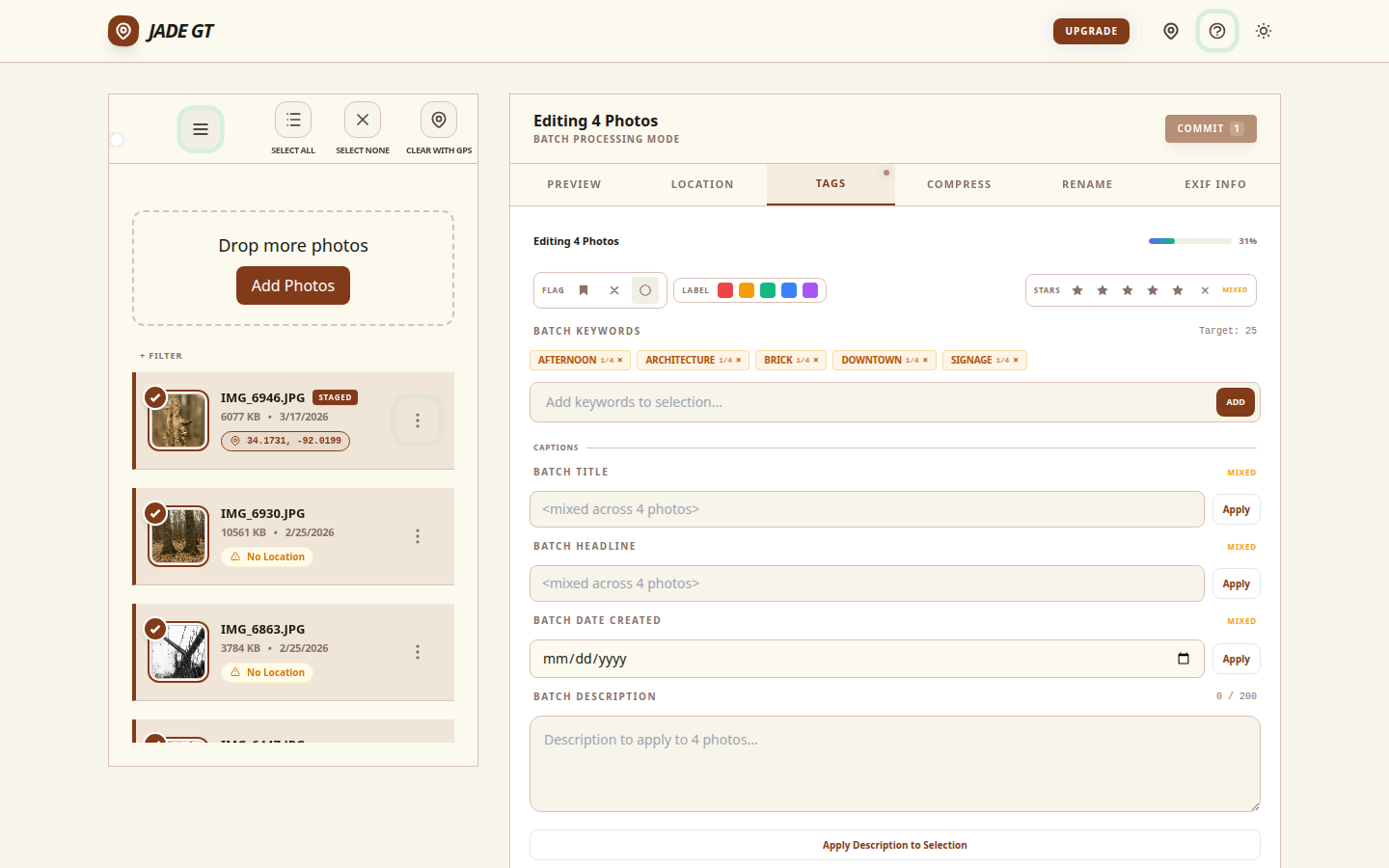
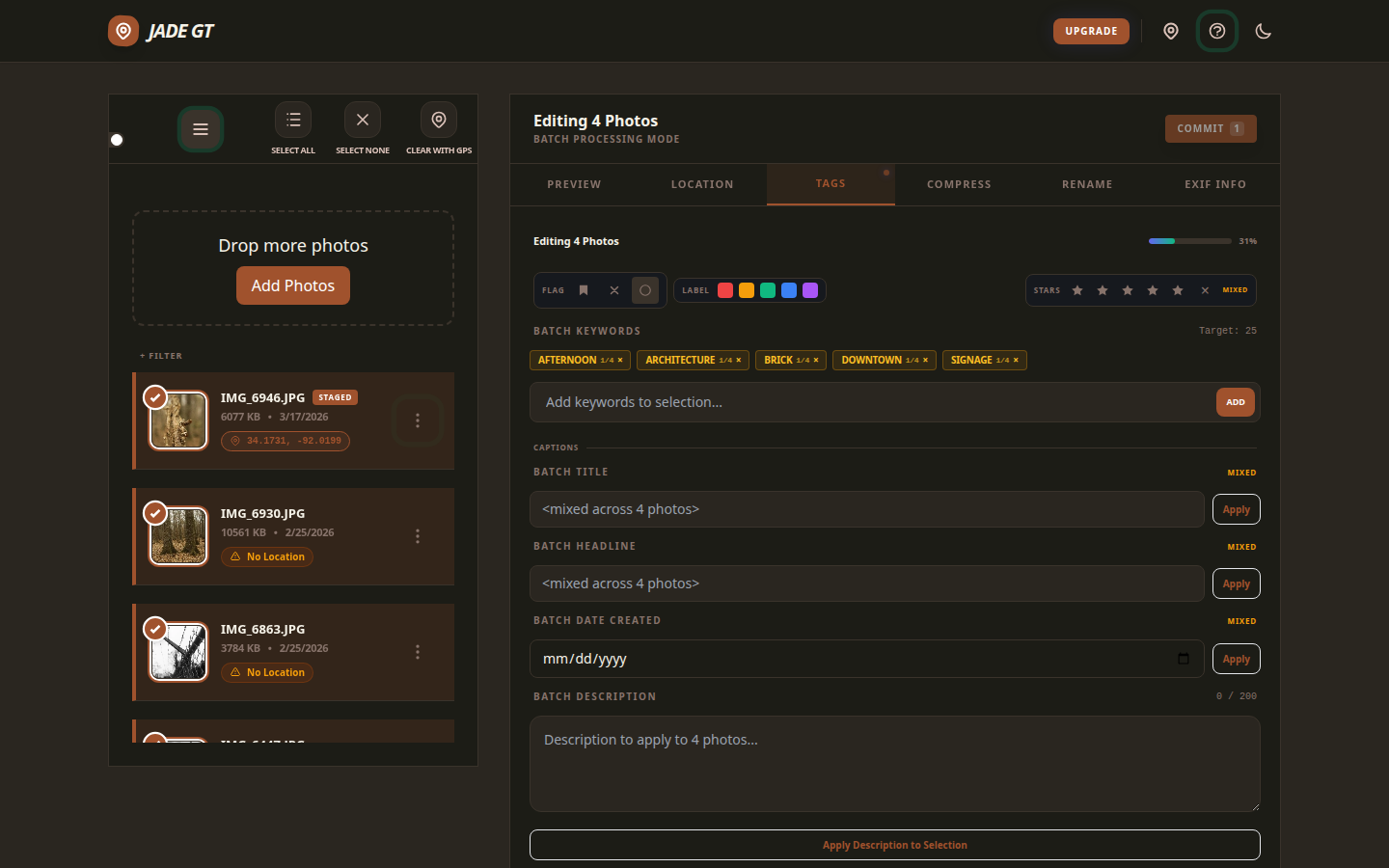
Open Jade GT in your browser, drop the folder of frames, and select the batch. The Tags panel writes dc:rights, dc:creator, xmpRights:UsageTerms, xmpRights:WebStatement, and photoshop:Instructions straight into the files. Set the public-space candid line as your default for the whole take, then select the handful of recognizable-face frames and overwrite their Rights Usage Terms and Instructions with the stronger caution. The released frames get the third treatment. Three passes, decreasing in size, and the whole edit happens on your machine.
Nothing uploads. Jade GT runs entirely in the browser, so the frames never leave your drive, which for street work means the recognizable strangers in them are never handed to a third party as the price of tagging them. When you import into Lightroom, Capture One, or a stock platform afterward, the rights block is already populated and already reads correctly in their IPTC panels.
What Jade GT is not
Two edges to know before you lean on this
- Not a release-management system. Jade GT records that a release exists and where to find it. It does not store the signed document or chase signatures. Keep the actual paperwork in your contract system.
- Not legal advice, and not a substitute for registration. The rights line you write is documentation, not a filing. Registering your batch through the Copyright Office is the step that unlocks statutory damages, and the metadata does not replace it.
The metadata layer records your judgment and makes it travel. The law, the paperwork, and the registration are still their own jobs.
FAQ
Do I legally need a model release for street photos I publish in a zine?
Generally no for editorial and fine-art use in the US, where there is no expectation of privacy in a public place. You generally do need one for commercial use such as advertising. The line is the use, not the frame. See the ASMP release tutorial and treat your photoshop:Instructions field as the place to flag which side a given frame sits on. This is general information, not legal advice.
Will these IPTC rights fields survive when I export from Lightroom or send a JPEG?
Yes. dc:rights, dc:creator, xmpRights:UsageTerms, xmpRights:WebStatement, and photoshop:Instructions are standard XMP properties that Lightroom, Capture One, Bridge, and stock platforms read and write by default. They ride inside the file, so a picture editor opening your JPEG in another city sees exactly the rights block you wrote.
What is the difference between Special Instructions and Instructions?
They are the same field. "Special Instructions" is the older IPTC IIM label that many tools still display; the standardized name is Instructions, mapping to photoshop:Instructions. If your software shows "Special Instructions," you are editing the same property described in the IPTC User Guide.
Can I stop my street photos from being used to train AI?
You can signal your intent. The IPTC standard includes a Data Mining field using PLUS vocabulary that lets you mark a frame as prohibited for AI or machine-learning training, documented in the IPTC User Guide. It is a declared restriction, not a technical lock, but it puts your position on record inside the file.
Try it on one take
Pick one street take you actually want to publish. Drop it into Jade GT, set the candid rights line as the batch default, then overwrite the two or three frames with recognizable faces. The rights pass takes about as long as it took to read this post, and the frames never leave your laptop.
If the rights block reads the way your published work needs it to, your next zine submission is already documented.
Sources
- What Photographers Should Know about Copyright (U.S. Copyright Office)
- Circular 42: Copyright Registration of Photographs (U.S. Copyright Office)
- IPTC Photo Metadata User Guide
- IPTC Photo Metadata Standard 2025.1 (specification)
- Property and Model Releases (ASMP Colorado tutorials)
- The Photographer's Right (Bert Krages, PDF)
- NPPA Code of Ethics for Visual Journalists
- Don't Take My Picture: Street Photography and Public Privacy (PetaPixel)
- Photo Attorney (Carolyn E. Wright)
- The Law and Ethics of Street Photography (Do Street Photography)
I shoot street, not contracts. If your frame does not fit the three types above, or you have a rights-metadata edge case I missed, reply or email. The next version of this post comes from the cases that did not fit.
Reply to Kenny
Questions, corrections, or a workflow story of your own? Send a note. It goes straight to my inbox.